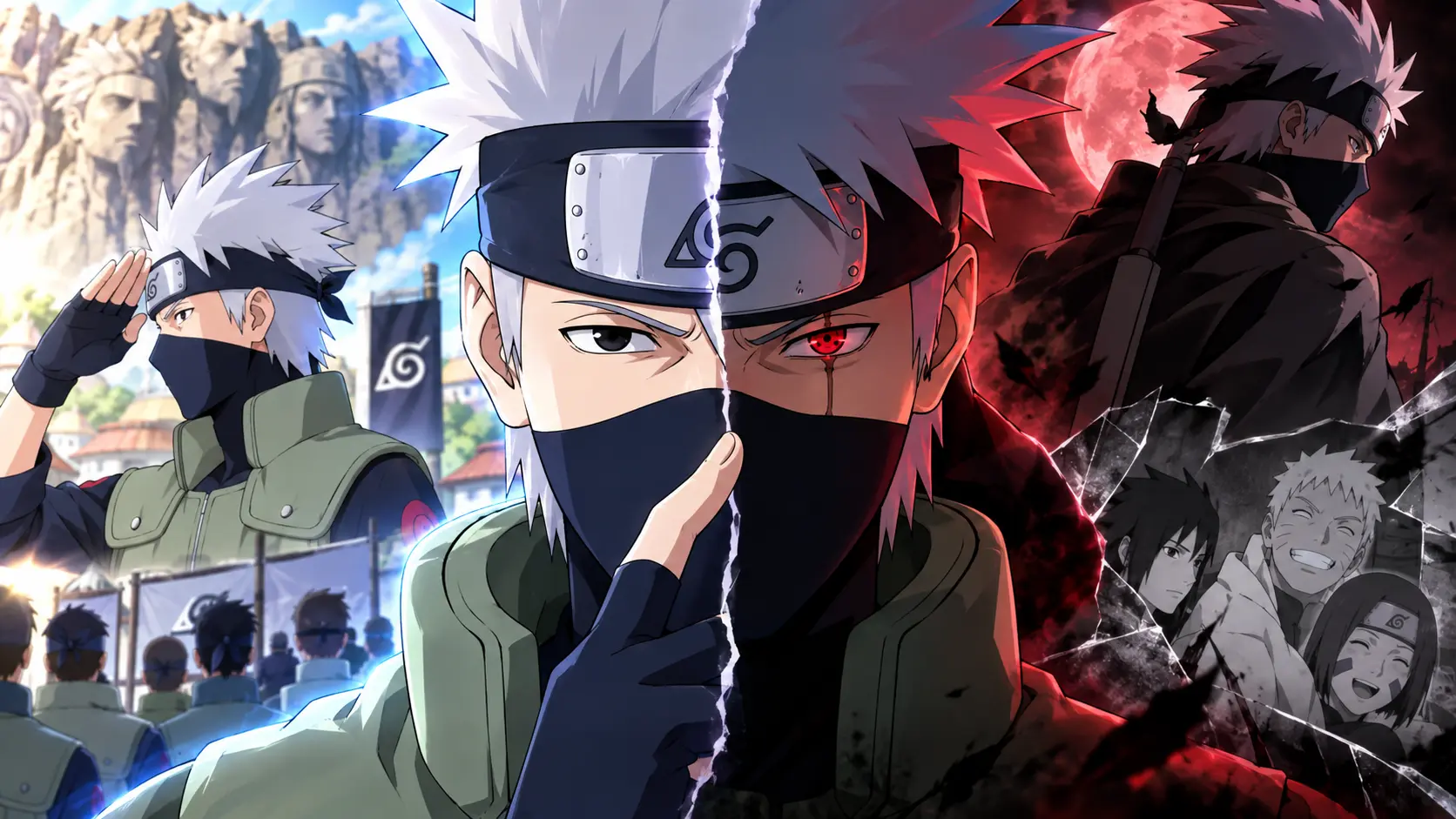





Kakashi is the son of Sakumo Hatake, a genius shinobi known as the “White Fang of the Leaf.” Kakashi deeply idolized his father, and the villagers of Konoha highly respected Sakumo, considering him even greater than the Legendary Sannin.
However, tragedy struck Sakumo. While leading a covert infiltration mission into enemy territory, he faced a massive dilemma: complete the mission for Konoha’s sake, or save the lives of his endangered comrades.
According to shinobi law, failing a mission is a grave offense. Yet, Sakumo chose to abandon the mission to save his teammates.
This decision carried heavy consequences. The Hidden Leaf and the Land of Fire suffered significant losses. The villagers—including the very comrades he saved—scorned and disgraced him. The unbearable social pressure drove Sakumo into a deep depression, ultimately leading him to take his own life.
From that moment on, Kakashi changed drastically. Stripped of his pride in Sakumo, he swore to strictly obey every shinobi rule. His father’s death became the catalyst for Kakashi’s rigid principles, earning him a reputation as a shinobi who followed regulations to the letter. Consequently, he grew to resent his father.
But Kakashi’s journey didn’t end there. A massive paradigm shift transformed him from a strict enforcer of rules into a man who valued humanity over rigid laws.
Here is how Kakashi Hatake’s transformation unfolded:
1. Kakashi Hatake: The Boy Who Followed Every Rule

As a child, Kakashi was obsessed with shinobi regulations. He firmly believed that “shinobi who break the rules are trash.” Therefore, he always prioritized mission success above all else.
Even when teammates were injured or left behind in enemy territory, Kakashi chose to ignore them to focus on the objective. This cold demeanor frequently sparked arguments with his peers and superiors.
During the Third Great Ninja War, the Third Hokage, Hiruzen, dispatched Team Minato to destroy the Kannabi Bridge, a crucial supply route for Hidden Stone shinobi. Their departure was delayed because Obito hadn’t arrived at the rendezvous point. When Obito finally showed up late, Kakashi immediately scolded him, lecturing him on the absolute importance of shinobi rules.
Kakashi knew the Shinobi Code by heart. When Obito panicked under an enemy attack and had to be saved by Minato, he made an excuse that dust had gotten in his eye, causing it to water. Annoyed, Kakashi sternly cited Rule 25, which states that a shinobi must never show tears.
Minato then split the team. Kakashi, Rin, and Obito were tasked with infiltrating behind enemy lines to destroy the bridge and retreating immediately. Meanwhile, Minato fought the enemy head-on to create a diversion.
However, Kakashi soon found himself facing the same dilemma as his father. He was caught between two impossible choices: continue the mission for Konoha’s sake, or save his teammate, Rin, who had been kidnapped by Hidden Stone shinobi. Without hesitation, Kakashi chose to proceed with the mission and abandon Rin.
This decision enraged Obito. He furiously berated Kakashi for abandoning their comrade. Kakashi responded by citing the rules, stating that a shinobi must be prepared to sacrifice a teammate for the mission’s success.
Despite the reminder, Obito chose to break the rules to save Rin. He boldly declared that he considered Kakashi’s father, Sakumo, a true hero. Obito acknowledged that those who break the rules are trash, but added, “Those who abandon their friends are worse than trash.”
Obito’s words struck a chord in Kakashi’s heart. For the first time, he doubted his rigid principles. Ultimately, he repented and stopped blindly following the rulebook. Kakashi joined Obito to rescue Rin from the enemy.
This decision was a turning point, transforming Kakashi from a rigid rule-follower into a compassionate shinobi who cared for his comrades.
2. Kakashi Hatake Teaches His Students to Break the Rules

After serving ten years in the Anbu Black Ops and rising to the rank of Captain, the Third Hokage ordered Kakashi to step down. Instead, Hiruzen assigned him to be a Jonin instructor in charge of guiding Genin.
Despite being assigned three recent Academy graduates, Kakashi didn’t immediately accept them. He established a rigorous qualification test to determine if they were truly fit to be shinobi and a part of his team.
One of his testing methods took place during lunch. He would tie one Genin to a wooden post and give two bento boxes to the other two. Kakashi laid down a strict rule: the two free Genin were absolutely forbidden from feeding their tied-up teammate. After issuing the order, Kakashi would pretend to leave.
Obedience carried a heavy consequence. If the Genin followed Kakashi’s order and refused to share, Kakashi would deem them unworthy and send them back to the Academy.
Team 7—Sakura, Sasuke, and Naruto—faced this exact test. Caught trying to steal food, Naruto was tied to the post. Kakashi gave the bento boxes to Sakura and Sasuke, strictly forbidding them from feeding Naruto and threatening immediate disqualification for anyone who broke the rule.
Kakashi then seemingly vanished, giving the impression they were unobserved. From a distance, he watched his students. Unable to bear seeing Naruto starve right in front of them, Sakura and Sasuke chose to break the rules and feed him.
Kakashi suddenly appeared in front of Team 7, feigning intense fury. Yet, behind his fake anger, Kakashi officially passed them as his students.
His decision was rooted in the philosophy inherited from Obito: “Shinobi who break the rules are trash, but shinobi who abandon their friends are worse than trash.”
If Sakura and Sasuke had blindly followed the rules and ignored Naruto, they would have failed just like the previous teams. Their courage to prioritize a friend over the rules convinced Kakashi they were a team worth leading.
3. Kakashi Becomes Known for Being Late

Kakashi’s chronic tardiness frequently inconvenienced those around him. A prime example occurred during the Chunin Exams. Genma, the proctor, was forced to repeatedly delay Sasuke and Gaara’s match because Kakashi hadn’t arrived with his student. The waiting crowd grew furious, and Sasuke was nearly disqualified.
Right before the deadline, Kakashi appeared with Sasuke. Genma pardoned the delay, realizing Sasuke was Kakashi’s student and assuming the teacher’s bad habit had simply rubbed off on the boy.
This habit surfaced again during the Third Hokage’s funeral. While the ceremony was already underway, Yugao stumbled upon Kakashi standing at the Memorial Stone, staring at Obito’s engraved name.
As Kakashi’s former Anbu subordinate, Yugao knew he was stalling. She advised him that it was better to show up early than to constantly make excuses for being late.
Almost all of Kakashi’s colleagues were accustomed to his tardiness. Ironically, he seemingly adopted this trait from Obito, despite being incredibly punctual as a child.
In his youth, Kakashi despised Obito’s constant lateness. During Team Minato’s official photo shoot, Obito arrived late, causing the photographer to lose his patience while Minato and Rin desperately stalled. Kakashi, holding back his own annoyance, completely understood the photographer’s frustration.
When Obito finally arrived with a wide grin, the photographer and Kakashi were thoroughly irritated. Minato was just baffled by Obito’s chronic lateness, as if it were an unchangeable character flaw.
When Team Minato was first formed, Kakashi furiously scolded Obito for being late to introductions. The strict, young Kakashi lectured Obito on the importance of following shinobi rules.
The irony came full circle years later when Kakashi, now a Jonin instructor, was late to the formation of Team 7. He intentionally stalled by visiting the Memorial Stone—a personal ritual—leaving Sakura, Sasuke, and Naruto waiting at the Academy.
Obito’s lateness had also caused issues during a Team Minato meeting, where he claimed he got “lost on the path.” The rule-bound Kakashi had scolded him, noting that such carelessness could endanger the team during a mission. Ironically, Kakashi frequently used the exact same excuse—”I got lost on the path of life”—when showing up late for Team 7.
This tardiness seemed to be a symbolic act of rebellion, showing he was no longer an absolute slave to the rules. After years of rigid obedience, it became an act of defiance against his past self. For Kakashi, being late was a form of self-punishment for his youth, when he prioritized rules above all else.
Kakashi harbored deep regret over Obito’s tragedy. When Obito was crushed by a boulder and lay dying, Kakashi realized his blind obedience to the rules had been a fatal mistake. He regretted not listening to Obito’s plea to save Rin sooner. Because of his decision, Kakashi had to watch his friend die a tragic death.
That lingering regret became the harsh lesson that transformed Kakashi from the “ultimate rule-follower” into a man who valued human connections far more than regulations.
4. Kakashi’s Lateness Karma: Finally Forced to Wait

After constantly making others wait and causing endless frustration, Kakashi finally reaped what he sowed. This time, he was the one forced to wait for someone who was late: Naruto.
As Kakashi prepared to step down as the Sixth Hokage, he looked forward to a peaceful life relaxing in the hot springs. However, before he could enjoy his retirement, he faced a highly frustrating situation.
Naruto, who was set to be inaugurated as the Seventh Hokage, failed to show up for the ceremony, even as the entire village gathered to welcome their new leader.
Kakashi’s confusion peaked when Hinata arrived carrying the Seventh Hokage’s cloak. It turned out she was also just finding out that Naruto hadn’t arrived at the venue. Consequently, Kakashi, who was in charge of leading the inauguration, went into full panic mode. The problem wasn’t just that Naruto was late—he was entirely missing from his own inauguration.